
In today’s digital world, calculators are everywhere.
Phones have them. Tablets have them. Even wristwatches have them.
So many parents ask:
“If calculators are available, why should my child learn abacus?”
The real question is not convenience.
The real question is brain development.
When comparing abacus vs calculator for children, the difference is clear: one trains the brain, the other replaces it.
What Happens When a Child Uses a Calculator?
A calculator is designed for speed and convenience.
You press buttons. You get answers.
While this is useful in advanced stages of education, early dependence on calculators can:
- Reduce mental effort
- Limit number sense development
- Decrease working memory engagement
- Encourage shortcut thinking
According to insights from the National Institutes of Health, active mental engagement strengthens neural connections. Passive tools do not stimulate the brain the same way.
A calculator gives answers.
It does not build thinking skills.
What Happens When a Child Learns Abacus?
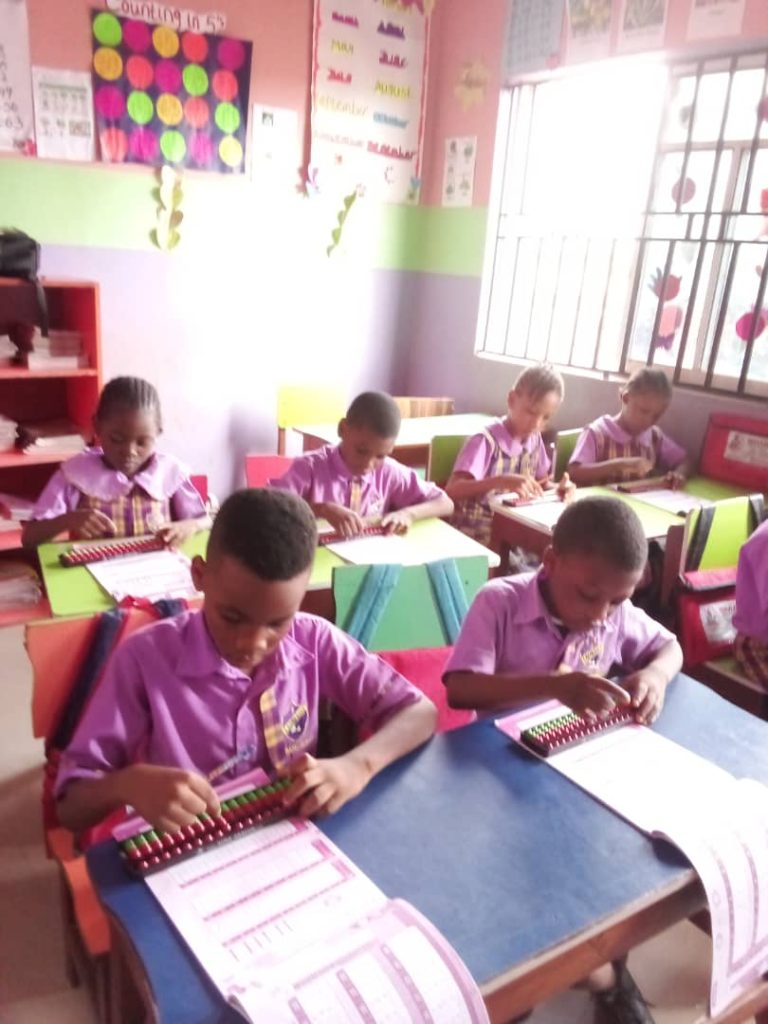
Abacus learning is active brain training.
Children must:
- Understand number placement
- Move beads physically
- Visualize numbers mentally
- Solve step-by-step
Over time, they transition from physical beads to mental calculation — strengthening both logic and visualization.
Research discussed by Harvard University highlights that mental imagery activates important cognitive areas of the brain. This is exactly what happens during abacus mental calculation.
The result?
✔ Stronger memory
✔ Better focus
✔ Faster processing speed
✔ Improved confidence
Abacus vs Calculator for Children: The Core Difference
| Calculator | Abacus |
|---|---|
| Gives instant answers | Builds thinking process |
| Requires minimal brain effort | Requires deep concentration |
| Encourages dependency | Builds independence |
| Short-term convenience | Long-term cognitive growth |
The difference is clear.
A calculator solves today’s problem.
Abacus prepares your child for future challenges.
Why This Matters for Nigerian Children
In Nigeria’s competitive academic system, children face:
- Timed examinations
- Entrance tests
- Continuous assessments
- Increasing academic pressure
Children who develop strong mental calculation skills early are more confident and less anxious during exams.
If you’d like to understand how abacus also helps reduce fear of mathematics, read our related article:
When Should Children Use Calculators?
Calculators are helpful at advanced levels, especially for complex calculations in higher mathematics.
However, during foundational years, brain development should come first.
Early reliance on calculators may limit the natural development of number sense and problem-solving skills.
Abacus builds the foundation.
Calculators can come later.
When choosing between abacus vs calculator for children, the decision is not about technology.
It is about brain growth.
It is about confidence.
It is about preparing your child for long-term academic success.
Abacus does more than teach calculation.
It trains the brain to think.
Give your child more than quick answers — give them strong thinking skills.
Enroll today at SIMA Abacus & Mental Maths Academy and build your child’s brain the right way.
📞 +2348135178604, +2347017275320
🌐 www.simaabacus.com
Stronger minds today. Greater success tomorrow.