
When should a child stop counting fingers? This is a common question many Nigerian parents ask. If your child still uses fingers to solve simple maths problems, you may be wondering if it’s normal — or if it’s time for something better.
The truth is, finger counting is a natural starting point. But staying there too long can slow down your child’s mathematical growth.
Let’s break it down.
Is Finger Counting Bad?
No, it isn’t bad — especially in early childhood.
Children between ages 4–6 often use fingers as a visual and physical tool to understand numbers. It helps them connect quantity with symbols.
However, problems arise when:
- A child still counts fingers at age 8–10
- Simple addition takes too long
- They struggle with multi-digit calculations
- They avoid maths because it feels stressful
At this stage, finger counting becomes a limitation instead of a support.
The Right Age to Move Beyond Finger Counting
There is no “magic age,” but most children should gradually move away from finger counting between ages 6–8, depending on their exposure and training.
By Primary 3 or 4, children should be able to:
- Add and subtract basic numbers mentally
- Solve simple word problems without physical counting
- Recall number combinations quickly
If this is not happening, your child may need structured mental maths training.
Signs Your Child Is Ready for Abacus Training
Here are clear indicators:
✔️ They understand basic number concepts
✔️ They can count forward and backward confidently
✔️ They show curiosity about numbers
✔️ They get frustrated when maths feels slow
Abacus training does not remove understanding — it strengthens it.
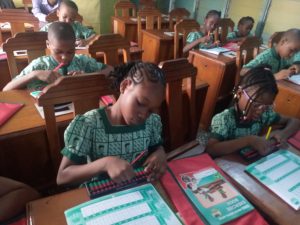
At SIMA Abacus & Mental Maths Academy, children are trained to visualize numbers mentally instead of relying on fingers. This improves:
- Speed
- Accuracy
- Focus
- Memory retention
According to research shared by the National Council of Teachers of Mathematics, strong number sense in early years directly impacts long-term mathematical success.
Why Early Mental Maths Training Matters
When a child depends on fingers for too long:
- They struggle with larger numbers
- Timed exams become stressful
- Confidence reduces
- Maths becomes something to “fear”
But when they transition to mental calculation:
- They solve problems faster
- They feel smart and capable
- They participate more in class
- Their overall academic confidence improves
This is why many forward-thinking schools in Nigeria now partner with structured mental maths academies to strengthen foundational skills.
From Fingers to Mental Visualization
The goal is not to rush your child.
The goal is to guide them.
Abacus training helps children move from physical counting to mental visualization, where they can calculate even complex numbers quickly and accurately — without writing or finger counting.
And the earlier the transition, the stronger the foundation.
Final Thoughts for Parents
If your child still counts fingers occasionally, don’t panic.
But if they rely on it for most calculations beyond age 7–8, it may be time to introduce structured mental maths training.
At SIMA Abacus & Mental Maths Academy, we help children develop speed, accuracy, and confidence through proven abacus techniques.
📞 Schools are welcome to partner with us to train their students.
📱 Call us today: +2348135178604, +2347017275320
🌐 Visit: www.simaabacus.com
Give your child the advantage of strong mental maths skills today.