
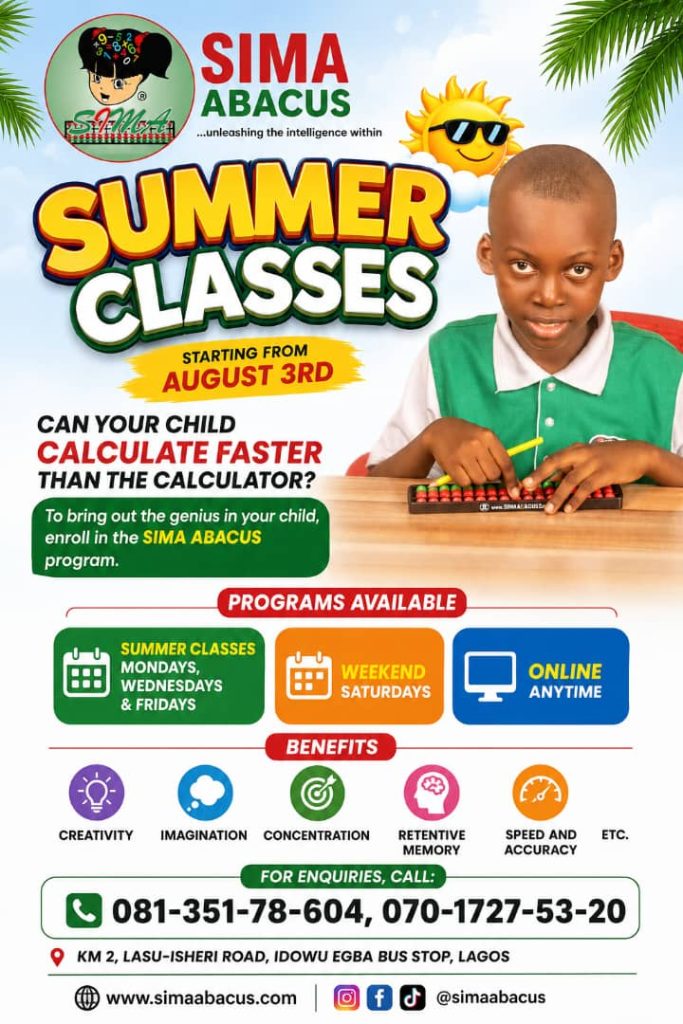
Every child has the potential to learn, think, create, and solve problems. But developing that potential requires more than memorising facts or completing school assignments. Children also need opportunities to strengthen the mental skills that support how they learn.
This is where the SIMA Abacus Method offers a different approach to learning.
The SIMA Abacus Method combines abacus-based learning, visualisation, concentration, memory, speed, and accuracy to help children develop important cognitive abilities. Rather than focusing only on getting the right answer, the method encourages children to actively engage their minds throughout the learning process.
For children between the ages of 3 and 13, this approach can provide a structured way to build foundational learning skills while making mathematics more engaging.
What Is the SIMA Abacus Method?
The SIMA Abacus Method is a structured learning approach that uses the abacus as a tool for developing mathematical and cognitive abilities.
Through consistent practice, children learn to work with numbers using both physical manipulation of the abacus and mental visualisation.
As children progress, they gradually move from physically working with the abacus to imagining the beads in their minds. This transition encourages them to perform calculations mentally rather than depending entirely on writing or physical tools.
More Than Learning to Calculate
One of the important features of the SIMA approach is that abacus learning is not treated simply as a way to teach arithmetic.
Children are encouraged to develop skills such as:
- Concentration
- Visual memory
- Mental calculation
- Speed
- Accuracy
- Listening
- Observation
- Problem-solving
- Confidence
These skills can contribute to a child’s overall learning experience, both inside and outside the classroom.
How the SIMA Abacus Method Supports Whole-Brain Development
Learning involves multiple mental processes. A child may need to listen to information, remember it, visualise it, process it, and respond appropriately.
The SIMA Abacus Method incorporates several of these processes into its learning activities.
1. It Strengthens Concentration
Concentration is an important foundation for effective learning.
When children work with numbers on an abacus, they need to pay attention to the instructions, identify the correct numbers, manipulate the beads, and follow calculations in sequence.
Regular practice can encourage children to sustain their attention on a specific task.
This ability to focus can be useful beyond mathematics. A child who learns to concentrate during abacus practice can apply the same habit when reading, writing, solving problems, or completing schoolwork.
2. It Encourages Visual Memory
Visualisation plays an important role in the SIMA Abacus Method.
As children become more advanced, they are encouraged to imagine the abacus and its beads mentally. Instead of physically moving the beads, they begin to picture the movements in their minds.
This creates an opportunity to exercise visual memory—the ability to retain and recall information that has been seen.
For a child, this can support learning activities that require remembering shapes, patterns, numbers, sequences, and visual information.
3. It Develops Mental Calculation
One of the most recognisable benefits of abacus training is the development of mental arithmetic skills.
Children gradually learn to perform calculations mentally by visualising the abacus.
Instead of relying solely on paper and pencil, they learn to process numbers within their minds.
This can help children become more comfortable working with numbers and develop greater confidence when approaching mathematical problems.
4. It Builds Speed and Accuracy
Mathematics requires both speed and accuracy.
Getting an answer quickly is useful, but getting it correctly is even more important. The SIMA Abacus Method gives children opportunities to practise both skills through repeated calculations and structured exercises.
With consistent practice, children can become more familiar with numbers and calculation patterns.
The goal is not simply to rush through problems. It is to help children develop the ability to process information efficiently while maintaining accuracy.
5. It Encourages Active Learning
Children learn differently when they actively participate in the learning process.
Instead of simply listening to an explanation, abacus learners interact with numbers, manipulate beads, visualise calculations, and respond to instructions.
This creates a more active learning experience.
Active participation can help children become more engaged with what they are learning and encourage them to take greater responsibility for solving problems.
The Role of the Abacus in Developing Mathematical Thinking
The abacus gives children a physical representation of numbers.
Instead of seeing numbers only as symbols written on a page, children can represent quantities using beads.
This can make abstract mathematical concepts more concrete, particularly for younger learners.
From Physical Beads to Mental Images
The learning journey can gradually progress from:
Physical Abacus → Visualisation → Mental Calculation
At the beginning, children physically manipulate the beads.
As their skills develop, they learn to visualise the abacus without physically touching it.
Eventually, they can use that mental image to perform calculations.
This progression is one of the interesting aspects of abacus-based learning because it combines physical interaction with mental processing.
Why Visualisation Matters in Learning
Visualisation is a powerful learning skill.
When children can create mental images of information, they have another way of processing and remembering what they learn.
In the SIMA Abacus Method, visualisation is particularly important because children learn to imagine the position and movement of abacus beads while performing calculations.
Turning Numbers Into Mental Pictures
For many children, numbers can initially feel abstract.
The abacus provides a visual and physical representation that can make numbers easier to understand.
With practice, children can begin to associate numerical values with mental images.
This can make the learning process more interactive and help children develop a stronger relationship with numbers.
How SIMA Abacus Can Support Better Learning Habits
The benefits of structured abacus practice can extend beyond calculation.
Children who participate regularly in learning activities develop habits such as paying attention to instructions, completing tasks, checking their answers, and practising consistently.
These habits can be valuable in other areas of education.
Learning to Listen Carefully
Abacus exercises often require children to listen carefully and respond to information.
This encourages active listening—a skill that is important in classrooms, conversations, examinations, and everyday life.
Learning Through Practice
Like many skills, mental calculation improves with practice.
Children learn that progress comes from repeated effort rather than expecting immediate perfection.
This can encourage patience, discipline, and persistence.
SIMA Abacus and the Development of a Confident Learner
Confidence can influence how children approach learning.
A child who believes they can solve a problem is more likely to attempt it, learn from mistakes, and try again.
As children practise abacus calculations and begin to solve problems more efficiently, they may experience a growing sense of accomplishment.
Every successfully completed exercise can reinforce the idea that skills can improve through practice.
From “I Can’t” to “Let Me Try”
One of the most valuable learning attitudes a child can develop is the willingness to try.
Abacus training provides children with repeated opportunities to practise, make mistakes, correct themselves, and improve.
Over time, this can help cultivate a more positive approach to challenges.
Why Early Cognitive Development Matters
The early years of a child’s development provide important opportunities for building foundational learning skills.
Children between the ages of 3 and 13 are developing their ability to concentrate, remember information, recognise patterns, communicate, reason, and solve problems.
Providing them with engaging learning experiences during these years can help strengthen these foundational abilities.
This is why programmes that combine academic learning with cognitive development can be valuable additions to a child’s educational journey.
SIMA Abacus: Building Skills Beyond the Classroom
The purpose of learning should not be limited to passing examinations.
Children need skills that can help them think, adapt, communicate, solve problems, and approach challenges with confidence.
The SIMA Abacus Method brings together mathematical learning and cognitive skill development through structured abacus practice.
From concentration and visual memory to mental calculation, speed, accuracy, and problem-solving, the method provides children with opportunities to exercise their minds while developing their mathematical abilities.
A Stronger Foundation for Lifelong Learning
Every calculation a child performs is more than just another mathematics exercise.
It can be an opportunity to practise concentration.
It can be an opportunity to strengthen memory.
It can be an opportunity to improve accuracy.
It can be an opportunity to develop confidence.
And, most importantly, it can be an opportunity for a child to discover that their ability to learn can grow with practice.
Conclusion
The SIMA Abacus Method is about more than learning how to calculate with an abacus. It is an approach that encourages children to engage their minds through concentration, visualisation, memory, mental calculation, speed, and accuracy.
By moving from physical abacus manipulation to mental visualisation, children are given opportunities to develop important cognitive and mathematical skills.
For parents and educators looking for ways to make learning more engaging while supporting children’s cognitive development, abacus-based learning can be a valuable part of the learning journey.
Every child has potential.
The right learning environment can help unlock it.
Help Your Child Unlock Their Learning Potential
Discover how SIMA Abacus can support your child’s mathematical and cognitive development through a structured whole-brain learning approach.
SIMA Abacus — Developing Minds, One Calculation at a Time.