
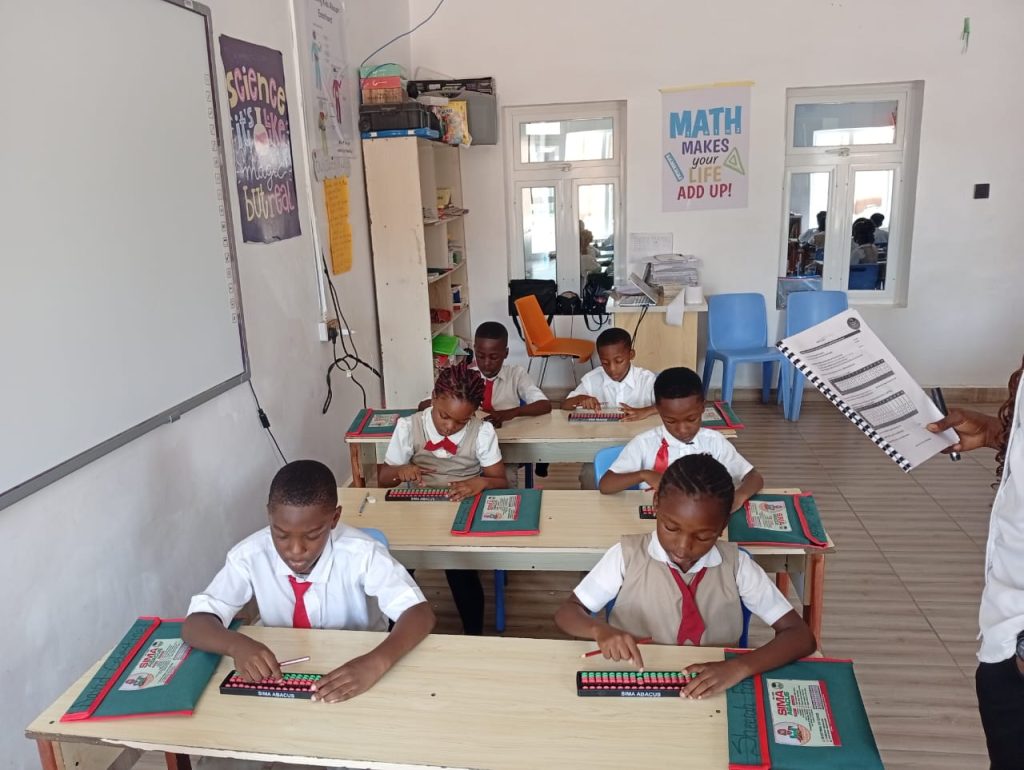
Many parents don’t realize the early signs your child needs mental maths training until school results begin to drop. The truth is, maths struggles rarely start in secondary school — they begin in primary classes when number confidence is not properly built.
At SIMA Abacus, we’ve worked with many Nigerian children who showed subtle warning signs long before parents took action. Here are five important indicators to watch for.
1) Slow Calculation Speed During Tests
Does your child understand maths but take too long to answer simple questions?
Speed matters in:
- Common entrance exams
- Scholarship tests
- Timed class assessments
When a child processes numbers slowly, they may leave questions unanswered — even when they know the solution.
Abacus mental maths training strengthens number visualization and improves calculation speed dramatically, allowing children to solve problems faster and more accurately.
2) Overdependence on Fingers or Calculators
If your child still counts with fingers for basic addition or subtraction, it may signal weak number sense.
Healthy number sense means:
- Recognizing patterns quickly
- Breaking down numbers mentally
- Calculating without physical aids
According to educational research from organizations like the National Numeracy initiative, strong early number foundations are essential for lifelong maths success.
Abacus training develops internal visualization skills, reducing reliance on external tools.
3) Avoidance of Maths Homework
Does your child suddenly:
- Delay maths assignments?
- Become frustrated quickly?
- Claim maths is “too hard”?
Avoidance is often rooted in lack of confidence — not intelligence.
Mental maths training changes the child’s relationship with numbers from fear to familiarity.
4) Low Confidence in Class Participation
Some children know the answer but hesitate to raise their hands.
Why?
Because they are unsure of their calculation accuracy.
Children trained in abacus mental maths often:
- Answer quickly
- Participate more confidently
- Feel proud of their ability
Confidence in maths often spills into other subjects as well.
5) Difficulty Concentrating During Numerical Tasks
Mental maths is not just about numbers — it strengthens focus and memory.
If your child:
- Gets distracted easily during maths
- Struggles to hold numbers in memory
- Forgets steps midway
It may indicate weak cognitive processing skills that abacus training is designed to improve.
In fact, you can read more about how abacus enhances brain development in children in our related article:
👉 How Abacus Training Improves Brain Development in Children (internal link)
Why Early Intervention Matters
The earlier a child develops strong number skills, the easier advanced mathematics becomes later in life.
Delaying support can lead to:
- Maths anxiety
- Poor exam performance
- Reduced interest in STEM subjects
Mental maths is a foundational skill, not an optional extra.
How SIMA Abacus Helps
At SIMA Abacus & Mental Maths Academy, we provide structured abacus training that helps children:
✔ Improve speed and accuracy
✔ Strengthen concentration
✔ Build academic confidence
✔ Develop lifelong number skills
Our programs are specially designed for Nigerian children and align with modern academic demands.
If you notice any of these signs your child needs mental maths training, now is the best time to act.
Contact us today via www.simaabacus.com to enroll your child and give them a powerful academic advantage.