
Every child begins maths the same way — counting fingers, objects, or dots on a page.
But at some point, successful learners make a silent transition: they stop counting and start seeing numbers in their mind.
This invisible shift is called mental visualization in children, and it is one of the most powerful cognitive changes abacus training creates.
The Finger-Counting Phase: A Natural Starting Point
Finger counting is not a weakness. It is a developmental stage.
At this level, children:
- Rely on physical support to understand quantity
- Process numbers one step at a time
- Struggle when numbers get larger or faster
The challenge begins when children remain stuck at this stage for too long.
Why Many Children Never Move Beyond Finger Counting
In many learning environments, children are pushed to “stop using fingers” without being taught what to replace them with.
As a result:
- Fingers disappear
- Confusion increases
- Guessing replaces understanding
The problem is not the removal of fingers — it is the absence of mental structure.
The Missing Bridge: Mental Visualization
Mental visualization is the ability to:
- See numbers as structured quantities
- Manipulate them mentally
- Understand relationships without physical aids
This skill does not develop automatically.
It must be trained deliberately.
How Abacus Creates the Hidden Learning Shift
Abacus works because it acts as a bridge between physical counting and mental imagery.
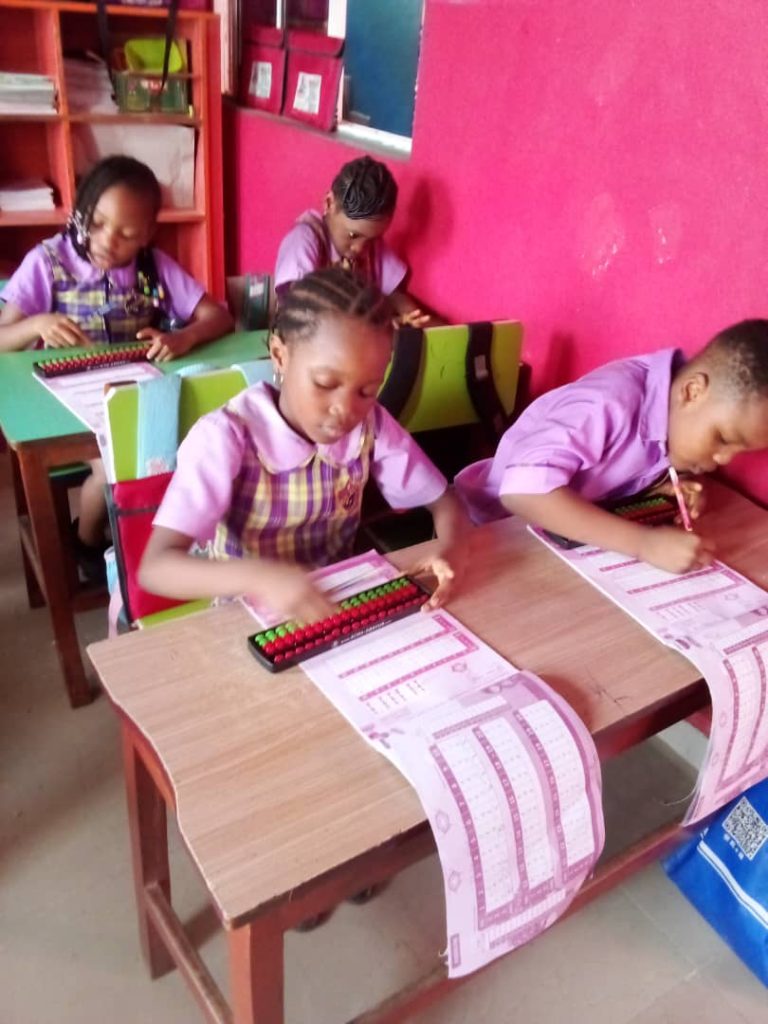
Stage 1: Physical Interaction
Children touch, move, and group beads.
This strengthens number sense and spatial awareness.
Stage 2: Visual Memory Formation
With repetition, the brain begins to remember bead patterns instead of individual movements.
Numbers become pictures, not symbols.
This is where mental visualization in children begins to form.
Stage 3: Internalization
Eventually, the physical abacus is no longer needed.
Children “see” the abacus in their mind and calculate mentally.
At this stage:
- Fingers are replaced naturally
- Speed emerges as a by-product
- Confidence increases significantly
What Is Happening Inside the Brain
Abacus training activates and strengthens:
- Working memory
- Visual-spatial processing
- Neural pathways linked to focus and reasoning
Research in cognitive education shows that visualization-based learning improves long-term understanding, not just short-term performance.
Why This Cognitive Shift Matters Beyond Maths
Once children master mental visualization:
- Reading comprehension improves
- Problem-solving becomes calmer
- Learning feels less stressful
Maths becomes a thinking exercise, not a fear trigger.
To see how this confidence impacts overall learning, read:
What Parents Commonly Observe
Parents often notice:
- Children stop using fingers on their own
- Calculations feel “effortless”
- Improved attention span
- Increased confidence across subjects
These are signs of internal cognitive growth, not rote learning.
Abacus Is Not Just Mental Maths — It Is Mental Structure
Mental maths focuses on results.
Abacus focuses on how the mind gets there.
By guiding children from physical counting to mental visualization, abacus reshapes how they think, learn, and solve problems.
Final Thought for Parents
If your child still relies heavily on fingers, it is not a failure — it is a signal.
With the right training, children do not abandon fingers because they are forced to —
they let go because their mind has learned something better.
At SIMA Abacus, we guide children through this hidden but powerful learning shift.
📞 Call: +2348135178604 | +2347017275320
🌐 Visit: www.simaabacus.com