
Mathematics is one of the most important subjects children encounter in school. From learning basic numbers and addition to solving complex mathematical problems, children gradually build the skills they need for academic success and everyday life.
But there are different ways children can develop their mathematical abilities.
Traditional mathematics education generally focuses on teaching mathematical concepts, formulas, written calculations, problem-solving methods, and applying these skills to different situations.
Abacus training, on the other hand, introduces children to mathematics through a physical calculating tool and gradually moves them toward mental calculation and visualization.
So, when it comes to abacus vs. traditional math, which approach is better?
The answer is not necessarily one or the other.
Rather than viewing abacus training and traditional mathematics as competing methods, parents and educators can see them as approaches that can complement each other.
What Is Traditional Math Learning?
Traditional mathematics learning is the approach most children experience in school.
It typically involves teaching children mathematical concepts through classroom instruction, textbooks, written exercises, demonstrations, assignments, and examinations.
Children learn skills such as:
- Addition and subtraction
- Multiplication and division
- Fractions and decimals
- Measurement
- Geometry
- Algebra
- Word problems
- Mathematical reasoning
- Problem-solving
Traditional mathematics provides children with the academic foundation they need to understand how numbers and mathematical concepts work.
It also teaches children how to apply mathematical principles to real-life and academic problems.
What Is Abacus Training?
An abacus is a calculating tool consisting of beads arranged on rods or columns. Children learn to represent numbers using the beads and perform calculations by moving them in specific ways.
With structured training and consistent practice, children can progress from using the physical abacus to visualizing the abacus mentally.
This transition is an important part of abacus learning.
Instead of relying entirely on written calculations, children learn to picture numbers and bead movements in their minds while performing calculations.
This can make abacus training an interesting way to practise mental mathematics.
Abacus vs. Traditional Math: What’s the Difference?
The major difference is often in how children engage with numbers.
Traditional mathematics frequently emphasizes understanding mathematical concepts and applying rules and methods to solve problems.
Abacus training places significant emphasis on manipulating numbers through the abacus, visualization, mental calculation, repetition, and speed and accuracy.
Both approaches can develop valuable skills, but they may emphasize different aspects of mathematical learning.
| Traditional Math | Abacus Training |
|---|---|
| Focuses on mathematical concepts | Focuses strongly on calculation and visualization |
| Uses written methods extensively | Uses physical and mental abacus techniques |
| Develops mathematical reasoning | Develops mental calculation and visualization |
| Covers a broad range of mathematical topics | Provides structured calculation practice |
| Commonly follows school curriculum | Usually follows a specialized training program |
| Uses formulas, symbols and written steps | Uses beads, visualization and mental processing |
The two approaches do not have to be separated. In fact, children can benefit from exposure to both.
1. Abacus Training Can Strengthen Mental Calculation
One of the most recognizable benefits of abacus learning is the development of mental calculation skills.
Children begin by performing calculations using the physical abacus. As they become more experienced, they can learn to visualize the abacus and perform calculations mentally.
This provides regular practice in working with numbers without always depending on paper and pencil.
Traditional mathematics also develops calculation skills, but abacus training can provide additional structured practice specifically focused on mental calculation.
2. Traditional Mathematics Builds a Broad Mathematical Foundation
Abacus training should not be viewed as a replacement for traditional mathematics.
School mathematics introduces children to a wide range of concepts, including geometry, algebra, measurement, fractions, equations, graphs, and mathematical reasoning.
These concepts are essential for a complete mathematical education.
Abacus training can complement this foundation by giving children additional opportunities to practise numerical calculations and mental processing.
3. Abacus Learning Encourages Visualization
Visualization is an important part of advanced abacus training.
As children progress, they learn to imagine the abacus in their minds and mentally manipulate the beads.
This means that mathematical information is not only being written down—it is also being represented mentally.
Visualization can make learning more engaging and can encourage children to think about numbers in a different way.
4. Traditional Math Develops Problem-Solving Skills
Mathematics is about much more than getting the correct answer.
Children also need to understand why an answer is correct and how mathematical principles can be applied to different problems.
Traditional classroom mathematics provides opportunities for children to work through word problems, equations, logical questions, and real-life mathematical situations.
These experiences can help develop reasoning and problem-solving abilities.
5. Abacus Training Can Encourage Concentration
An abacus calculation requires children to pay attention to numbers and follow a sequence of operations.
As exercises become more challenging, children need to maintain their attention for longer periods and avoid losing track of the calculation.
Regular practice can therefore provide opportunities for children to strengthen concentration and attention.
6. Both Approaches Can Develop Accuracy
Accuracy matters in mathematics.
A child may calculate quickly, but if the answer is incorrect, speed has little value.
Abacus training encourages children to combine speed with accuracy through repeated calculation exercises.
Traditional mathematics also teaches children to check their work, follow mathematical procedures, and identify mistakes.
Together, these approaches can reinforce the importance of getting the process and the answer right.
7. Abacus and Traditional Math Can Work Together
The most important point is that parents do not necessarily need to choose between the two.
A child can learn mathematics in school while also participating in abacus training.
For example, a child may learn addition, subtraction, multiplication, and division through the school curriculum while using abacus exercises to gain additional practice in numerical calculations.
The two learning experiences can therefore complement each other.
Which Is Better for Children?
Instead of asking, “Is abacus better than traditional mathematics?”, a more useful question may be:
“How can both approaches help my child develop stronger mathematical and mental skills?”
Traditional mathematics provides a broad academic foundation.
Abacus training can provide focused practice in calculation, visualization, concentration, memory, speed, and accuracy.
The best approach depends on the child’s needs, learning environment, age, consistency, and the quality of instruction.
What Parents Should Look For in an Abacus Programme
If you are considering abacus training for your child, don’t focus only on how quickly the child can calculate.
Look for a programme that provides:
- Structured and age-appropriate lessons
- Qualified and supportive instructors
- Regular practice
- A balance between speed and accuracy
- Opportunities for mental calculation
- Visualization exercises
- Progressive learning levels
- Activities that keep children engaged
- A focus on broader learning and development
The quality of the learning experience is just as important as the tool being used.
The SIMA Abacus Approach
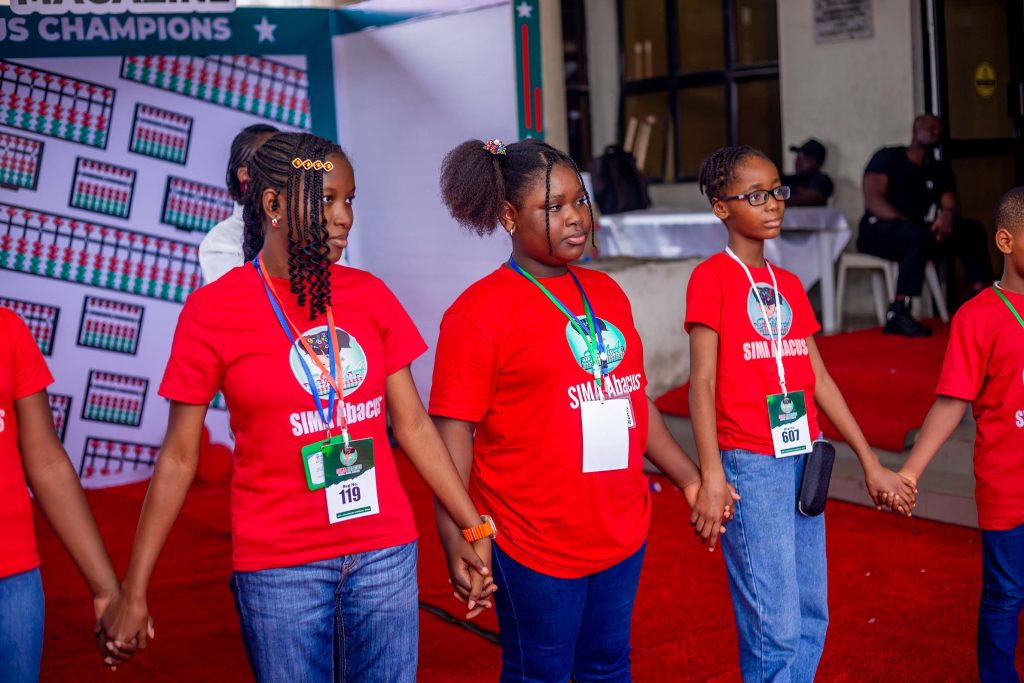
At SIMA Abacus, the goal is not simply to teach children how to move beads or calculate numbers quickly.
The SIMA approach uses abacus learning as part of a broader developmental process that encourages children to practise concentration, visual memory, mental calculation, speed, accuracy, and confidence.
Through structured learning and the use of the two-hand methodology, children are given opportunities to engage with numbers in an active and visual way.
This makes abacus training more than a calculation exercise. It becomes an opportunity for children to practise important mental skills while developing their mathematical abilities.
The debate about abacus vs. traditional math does not have to be about choosing one and rejecting the other.
Traditional mathematics gives children a broad foundation for understanding mathematical concepts, reasoning, and problem-solving.
Abacus training can complement that foundation by providing additional opportunities to practise mental calculation, visualization, concentration, memory, speed, and accuracy.
When used appropriately, both approaches can play valuable roles in a child’s learning journey.
Mathematics is not only about learning numbers. It is about developing the ability to think, reason, solve problems, and approach challenges with confidence.
At SIMA Abacus, we believe that every child deserves the opportunity to develop these abilities through the right training, guidance, and foundation.
SIMA Abacus — Building Minds, One Calculation at a Time.