
Many parents become worried when their child begins to struggle with mathematics in primary school. Homework becomes stressful, test scores drop, and confidence slowly disappears.
But the truth is surprising.
In many cases, the problem is not the child’s intelligence. The real issue is often the learning method used to teach numbers.
Understanding why children struggle with mathematics can help parents introduce better learning systems that build confidence and strong numerical thinking from an early age.
Mathematics Is Often Taught in a Slow Processing Way
In many classrooms, children are introduced to numbers using methods that rely heavily on memorization and slow counting.
For example, many children depend on:
- Finger counting
- Repeated memorization of steps
- Trial-and-error problem solving
While these methods may work in the short term, they often make mathematical thinking slow and difficult.
When a child processes numbers slowly, they can easily fall behind classmates and begin to believe that maths is simply “not for them.”
Lack of Strong Number Sense
Another hidden reason children struggle is the absence of strong number sense.
Number sense refers to a child’s natural ability to understand how numbers relate to each other.
Children with strong number sense can easily:
- Break numbers apart
- Recognize patterns
- Estimate answers quickly
- Perform mental calculations
Unfortunately, many traditional teaching approaches do not actively develop this skill.
Educational research from National Council of Teachers of Mathematics highlights that early number sense plays a major role in long-term mathematical success.
Fear and Low Confidence in Mathematics
When children repeatedly struggle with numbers, something else begins to happen: math anxiety.
They begin to feel nervous during math lessons or tests. Even simple calculations can feel overwhelming.
Over time, this fear can cause children to avoid mathematics completely.
Parents may then hear statements like:
- “Math is too hard.”
- “I am not good at numbers.”
- “I don’t understand maths.”
But in most cases, the child simply needs a different learning approach.
How Visual Learning Makes Mathematics Easier
Children naturally learn better when numbers are connected to visual systems rather than abstract memorization.
One powerful method is learning with the Abacus.
The abacus allows children to see numbers and move them physically, which makes mathematical concepts easier to understand.
With consistent training, children begin to visualize the abacus in their minds and perform calculations mentally.
This process develops faster thinking and stronger number understanding.
A Better Way to Build Strong Math Foundations
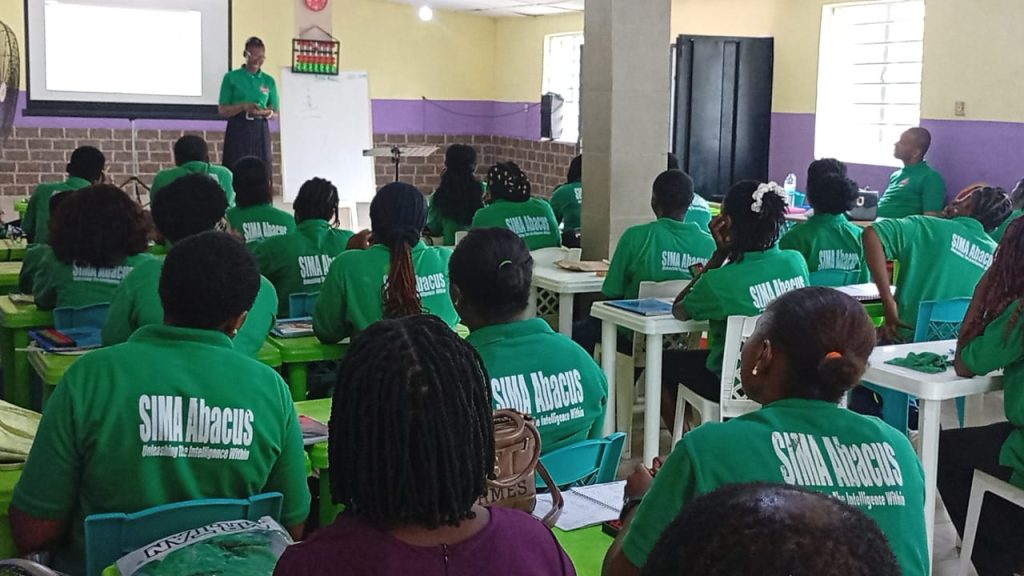
Programs like those offered at SIMA Abacus & Mental Maths Academy focus on developing mental calculation skills and strong number sense from an early stage.
Through structured abacus training, children gradually move from physical bead calculations to powerful mental maths ability.
Parents often notice improvements such as:
- Better concentration in school
- Faster calculation speed
- Increased confidence during math lessons
- Stronger academic performance
You can also read our related article:
“Why Abacus Learning Helps Children Develop Faster Mental Calculation Skills.”
The Right System Changes Everything
Every child has the ability to understand mathematics when the right teaching system is used.
When children learn numbers through structured mental maths training, they no longer depend on slow counting or memorization.
Instead, they develop confidence, speed, and clarity in solving problems.
At SIMA Abacus & Mental Maths Academy, we help children build these powerful thinking skills through proven abacus learning techniques.
To learn more about our programs and how your child can start developing stronger maths skills, visit www.simaabacus.com.